
BOX 787 DAVIS, CALIFORNIA 95617
email us at: Oldbicycle@aol.com

Click on the colored letters at right to : Send Email to NBHAA
HOW IT BEGAN*
(*How the classic bicycle hobby began and how it became what it is today.)
copyright ?Leon Dixon and NBHAA 1997, 1999, 2007, 2008, 2009, 2010, 2012, 2013. All rights reserved

?DID YOU KNOW THAT... 2012 WAS THE 35th ANNIVERSARY OF THE OFFICIAL BEGINNING OF THE CLASSIC BICYCLE HOBBY?
?DID YOU KNOW THAT... more than thirty-six years have passed since the first newsletter and official beginnings of the classic bicycle hobby took place?
?DID YOU KNOW THAT... thirty-four years have passed since the first coining and copyrighted DEFINITION of CLASSIC BICYCLE and the classic bicycle hobby took place?
Bet you didn't.
Thus, submitted for your approval is the first installment of NBHAA "HOW IT BEGAN"–the story of how the classic bicycle hobby began. THIS IS JUST A SAMPLE AND THIS AREA IS PRESENTLY UNDER CONSTRUCTION. CHECK BACK FOR NEW EXPANSIONS. We will be adding to this section over time, so stay tuned...come back and visit often for more info and expansions.
Today, there is a hobby of collecting and restoring classic balloon tire bicycles. It exists, battered, highly polarized, political, divided by fighting factions, unaware of its beginnings, without direction for a future, held back by pompous ignorance, often misled by know-it-all-but-know-nothing posers and gas bags... and in need of serious education, but it exists. There are swap meets, auctions, shows, events and collectors nationwide. Publications have come and gone–each claiming to be either better than what preceded it or lambasting the very predecessors upon which the latest one is built (but ironically imitating exactly what came before anyway).
Do-it-yourself (DIY) web sites have sprung up spreading stories of these bicycles (some of them true, many of them not) and assuring any amateur that all they have to do is merely look at some photos, swap WAG guesses with others who are also guessing or parroting and–oh yes–they too can be overnight experts! There are now books (most of which are not very good–some of which are worse than awful) and numerous publications on this hobby. There are internet "forums," chats, BLOGS. And gaggles of people who claim to be experts–in a hobby where the word "expert" usually translates to "they are... because they SAY they are–and they tell good stories"... and always have instant good-buddy-friendly sounding answers. The kind people would rather hear than facts. A lotta folks would rather be schmoozed than be told actual facts.
Museums–even the ones that once turned their noses up at balloon tire bicycles–now include these classics...and brag about them as if (ohhh yes) they were fans all along and have great expertise. Just ask them and they'll tell you.
Bicycle companies have repopped old models with mixed success. Various individuals are busily turning out reproduced parts, from fenders and tanks to handlebar grips. Even the Whizzer Motorbike has been resurrected. Auction companies have suddenly taken to selling and hawking these bicycles–all while pretending to know about them. There are fake, but decently and creatively executed character model Whizzers showing up at ritzy classic car auctions. Shops specialize in selling and "restoring" classic bicycles. So...the bell keeps on ringing on those cash registers. EVERYBODY is cashing in. If you want evidence, just take a look at vintage bicycles and parts on eBay! Kah-chinggggg! And...the very people who may criticize the originator of the hobby are the same folks making the most money off of it! THEY ought to be thanking us! And there are folks out there "analyzing the market"–as if this is all emotionless, passionless trading of stocks and bonds on Wall Street. And as if–oh yes THEY know where the "market" is going–even if they have no clue where it has been. And people complaining that "the bicycle market is DOWN" (how did it ever get UP in the first place???)... or some such stuff. But the whole time those bells are ringing, nobody can seem to remember how this all got started. And those who are making the most seem to be the least thankful of all.
It is certainly a very different world today for classic bicycles when compared to the early 1970s when almost nobody cared. But EVERYTHING begins somewhere, someplace, sometime. Things like this don't just fall out of the sky. And usually there is a lot of hard work involved–no matter how many people pop up years later and benefit from that earlier effort. It is always a lot easier to stand tall when you are doing it by standing on someone else's shoulders. Before long, they guy who had the hobby standing on his shoulders was feeling a LOT of weight–no matter how many wanted to pretend he wasn't even there while piling on top of him. Of course the big issue is if this is what makes you so tall, why can't you admit it?
This entire hobby had a start. It didn't just "happen" and anyone who tells you so, just try asking THEM where THEY were and what they were doing with these bicycles and their history in the late 1960s, the 1970s and the early 1980s. ASK THEM TO SHOW YOU! Ask us and we'll show you. In magazines. On paper. In print. ASK THEM! THEN ASK US.
And whatever the classic bicycle hobby is today... and all those ringing cash registers began with some events. It began with our very hard work and our efforts to educate everyone on the fact that vintage balloon tire bicycles WERE worth saving... COULD be hot collectibles... COULD make money for dealers...COULD be a fun and exciting hobby... WERE substantially different from pre-1920 antiques...and DID have a real HISTORY that was just as significant as the antique thingamajigs that ruled as "collectable" back then.
So... let’s go back to the 1960s when these bicycles certainly were forgotten and far from being considered collector items...
PART ONE:
DETROIT... THE REAL BEGINNINGS IN ANN ARBOR, MICHIGAN...
POPULAR MECHANICS MAGAZINE AMNESIA...
RECYCLED CYCLES IN NEWPORT BEACH, CALIFORNIA IN THE 1970s...
AND-JUST A LITTLE BIT ABOUT THE BEACH CRUISER FAD...
AND THE SCHWINN CALIFORNIA CRUISER...
copyright ?Leon Dixon, 2009. All rights reserved
I got my first bicycle catalogue in 1953... and I never stopped collecting them. I got my first bicycle in 1955 and I still have it today. For me, loving bicycles was never a political statement or some radical protest against cars. And it had nothing whatsoever to do with participating in a "sport" or eating nuts and berries. I never cared about how much a bicycle weighed and I couldn't tell you a darned thing about "cadence pedaling" or "carb loading." I never cared much about whether my bicycle had toe clips or a derailleur or a coaster brake (even though I own both). I just never viewed loving bicycles as being part of a "movement." And I never saw loving bicycles as an "US vs. THEM" kinda thing. QUITE the CONTRARY!
While perhaps not politically correct today in the 21st Century, I loved cars as much as bicycles. Still do. I was always fascinated by anything with wheels. Cars, bicycles, motorcycles. And I loved aircraft and trains. So my love for bicycles did not just happen out of the sky one day. I had always loved bicycles since I was old enough to say the word. In fact, I nearly lost one of my feet when one got caught in the front wheel of my cousin's Shelby bicycle (which–by the way–he got new). I was barely old enough to walk at the time (yes, it is in my baby book).
By the 1960s, I had begun a kind of pen-pal correspondence with an old bicycle man in Chicago, Corwin Thomas Bruck, who I simply knew as Tom. He was an expert on the early days of bicycles and taught me a lot about bicycle history in the USA. You see, Tom had been around to see it all happen. He was old enough to have personally known men like Gormally and Jeffrey (whom he worked for) and Colonel Pope. And countless others. He knew about the glory days of the bicycle industry in Chicago. He knew about BOTH Monarch and Monark. He knew the Schwinn family and even had his own key to the company library.
Anytime I had a question about some ancient bicycle history, Tom knew it. He knew the people, the factories, the bicycles themselves. As an old retiree, Tom lived in a single room, surrounded floor-to-ceiling with old bicycle literature and photos. Nobody ever loved bicycles more than Tom. And he had a memory that–despite his advanced age–was razor sharp! I learned a lot from him and later, from Keith Kingbay of Schwinn who was also a good friend to both of us and very nice man.
Whenever I was visiting the Chicago area, I would usually have lunch or dinner with Tom and Keith. Sometimes the lunches were at the employee cafeteria at the Schwinn Bicycle Company headquarters. Yes. Fact. After a meal sometimes we would retire to the Schwinn Library–which in those days was largely the paper item collection of Frank Schwinn. More on this later.
There was a lot of bicycle history in the Chicago area. I also acquired many of the bicycle records from a museum that once existed in the 1930s and 1940s in Illinois–long before there were today's bicycle museums. This included piles of letters, brochures, photos. Many of them went well back into the 1800s. And I got many of the bicycle files of long defunct "Hobbies" magazine out of Chicago which was in operation back in those times. (Drive down Michigan Avenue in downtown Chicago today and if you have sharp eyes you can still see the faded "Hobbies Magazine" sign painted on the wall of their once-grand building.) I read all of this stuff voraciously and did my best to learn from it.
Anyway, time rolled by. In 1968, I returned home from Viet Nam and the brutal experience of war. One of the first things I did was to get my car out of the garage. It was a 1963 Ford Galaxie 500 XL convertible–all black, loaded, with sporty bucket seats and console. It had the optional 390 cubic inch V8 with the Police Interceptor package that made it a very hot engine. I used to take my beautiful XL cruising and racing. I hung out at places like Totem Pole, The Egg & I, Big Boy, Big Town, Coral Gables, and Ted’s Drive-in Restaurant on the Detroit area’s North Woodward Avenue. This was decades before anyone ever thought of the famous Woodward Avenue Dream Cruise that exists today.
Behind the Ford XL (which, by the way, I traded that year for a brand-new Pontiac GTO convertible) in the garage was my beautiful J.C. Higgins bicycle, dusty, a bit rusty and forlorn from years of neglect. Right then and there I decided to clean my Higgins and restore it back to the way it was when I first got the bicycle. My dad bought it for me from the mighty Sears, Roebuck store that once stood on the corner of Van Dyke and Gratiot* avenues in Detroit, Michigan. (*BY THE WAY–don't believe this garbage that is rampant today on the internet that this street name was pronounced "gray-sha" by Detroiters. I grew up there and used that street regularly. NOBODY from Detroit's glory years would have called the street what these revisionists are perpetrating on the net for you youngsters! It was always pronounced "gra-shot" or even "gra-shit" but NEVER "gray-sha"... no matter how many young revisionists who were never there or Parisians my say it that way!!!)
Anyway, that beautiful bicycle had been stolen from me at a park in Detroit in 1958 and some parts were still missing–having never fully been recovered. So now it was a priority to put it all back like it belonged. And thus began an odyssey that in some ways, led far beyond anything I had dreamed. In others, far short of what I had hoped.
All during my boyhood, I lived, ate, slept and dreamed about bicycles. I memorized and knew every detail of every bicycle that rode in the endless parades on the sidewalk past my house all summer long in the 1950s. I never had to learn about these bicycles–I already knew them well. Monark, Schwinn, Ross, Manton & Smith (my sister had one which she got new), Colson, Rollfast, Shelby, Stelber, Western Flyer. These were all bicycles I saw daily...and knew and loved. Every time I got a new bicycle catalogue, it went into my precious pile. So by this time, whatever it was with old bicycles, I was ready!
I began the restoration work on my J.C. Higgins in Northwest Detroit. Several shops ended up selling me parts (Livernois Bike Shop, Jimmy's Bike Shop, Grand River Cyclery, Acme Bike Shop and others). Later, Dave's Bike Shop in Wayne, Michigan helped me lace up a new set of proper chrome rims. Many years earlier as a teen, I used to occasionally ride over to visit the famous Alexander Brothers (car customizers of the 1950s and 60s) at their shop (quite a trek from my house) and I picked up a few tips from them on bodywork and paint. I had met Mike Alexander years earlier when I won an award at Detroit's Cobo Hall for a special 1/25th scale model car I built (it was a Pontiac Tempest with a WORKING convertible top! My prediction of the real GTO which had yet to be made in 1963. This car was actually pictured in Model Car Science magazine, but wouldn't ya know it? The "idjuts" there captioned the photo with some other guy's name!). I had built championship model cars all during my teen years. Me and my buddies Conce (the REAL genius at this stuff), Mickey, Eric, and Vince all entered every model car contest we could find. And one of us usually won–sometimes ALL of the awards–like 1-2-3. Sometimes we'd tick off the hobby shop owner by winning all of his trophies, but frankly, we helped whomever it was sell a BUNCH of AMT, Revell and Monogram car kits! At one point, I won one of the top spots in the midwest region of the national Revell-Pactra World Modelrama contest and several of my models had been pictured in magazines. Anyway, with all this experience, I figured I knew enough to restore a simple bicycle.
I also had the experience of hanging out at every used bicycle shop I could find in the 1950s. My dad had commercial property and we rented a building to a fellow everyone knew as just "Mr. Green." He had PILES of ancient bicycles stacked in that building like cordwood. And he KNEW each and every one of them. He could just LOOK at any old rusty frame and tell you how old it was and when it was made–and THIS was in the 1950s when there really was a LOT of old stuff still around!
I was at Mr. Green's shop almost every day and he taught me how to rebuild a New Departure hub when I was only age 8. Green also knew and taught me how to identify frames and forks and how to tell when something had been changed. He even knew WHO (if it was done in the city at a shop) changed it! For instance, one shop always painted their refurbished bicycles a certain way. Another switched every hub to a certain brand. Green even did this himself. At one time, I estimate he may have had as many as 10,000 MORROW hubs stacked in his building. He LOVED the things! He used to say, "...boy! Deese MORRA hubs is hard ta build, but they the BEST! Ya hear me? Da BEST! Stick wid me and some day when ya daddy gives ya some extra time, I'll take a day and show ya how to rebuild a MORRA hub!" Between Morrow hubs and Schwinn bicycles (his OTHER favorite thing in the world–and he had a pile of them too and rode one for daily transportation), Green was in heaven!
Of course, the BEST and biggest USED bicycle shop (there once were lots of these in major American cities) in Detroit in the 1950s was out Mack Avenue on the East side. It was known back then as ACME Bike Shop. Owners changed over the years. At one time it was a Mr. Jackson... then a Mr. Rivers. It took up two buildings and filled the basements of at least two. The favorite of at least these two owners was what they called "Silva-Khang" (Silver King) bicycles and they had BUNCHES of them. PILES of them! It was here that I learned all about Silver Kings in the 1950s (some people today can't fathom that I know more about Silver Kings than anyone in the hobby, but they just don't understand that I have been studying these bicycles since the 1950s–and I learned about them not just by looking at them, but by having the original catalogues AND from learning from these two used bicycle shop MASTERS in the 1950s). And they had a lot of other bicycles, like Shelby and J.C. Higgins (which–so help me–the son of the owner referred to as "jaycee hiccup"). So by the time I was restoring my J.C. Higgins, I knew a huge amount about old balloon tire American bicycles.
Anyway, let's return to the end of the 1960s. A bit later, I moved to Ann Arbor, Michigan where the Higgins restoration was ultimately completed in the basement of my new townhouse. I rode this and other of my balloon tire bicycles to the U of M "diag" where I used to sit and have modern cyclists make fun of how "heavy" my old beautiful bicycles were. Those who imagined themselves as sophisticated expert bicyclists would wax endlessly on about how much bicycles weighed and how everything needed to be lighter... and on and on and on ad nauseum. One by one, they would beg to lift my bicycles and then chuckle about the weight as if this were the sole criteria to have a bicycle. Yet other people would continuously walk up and marvel at the designs... the chrome...the big whitewall tires... the electric horn... the spring fork. Remember, such bicycles were not available for sale then, and there were no repops. I was the first to ride, display, write about and restore classic bicycles in Ann Arbor. Yet, years later, no one could seem to remember my balloon tire bicycle parked on the Ann Arbor 'diag." Nor in the glass-enclosed lobby of Tower Plaza at 555 East William street (where I once also lived) back when that building was new–decades before others in Ann Arbor were claiming credit (even expertise) for loving balloon tire bicycles!
Now, today there are those who would say it is merely "ego" or "big bragging" to say I started the hobby or did anything FIRST. But when asked to show proof of who did any of this stuff BEFORE me, they either get very loud and rude... or very quiet–but either way, never come up with anything to show otherwise. There are even people who offer ridiculous alternative explanations that minimize what we did, saying things like, "well, it woulda happened anyway if you hadn't done it!" Silly stuff–you could say THAT about ANYTHING that ever was conceived by a human being! But where were THEY in 1968? Or in 1973? And what did THEY do that we can refer to today that was prior to 1973... or even IN 1973? NOTHING.
Anyway, in 1973, I contacted Bicycling! magazine (and yes, in those days the title of the magazine included an exclamation mark) about a bicycle I had refurbished. The bicycle in question was my original J.C. Higgins owned since new. Mine was a 1955-1/2 model and I wanted to alert the magazine to the existence of vintage balloon tire bicycles. The magazine then (as it is today) was solely focused on modern lightweight bicycles, 10-speeds and racing stuff. They were run by people who could talk for hours on the merits of lugged diamond lightweight frames and "Campy stuff" but they didn't have a clue what an Elgin Bluebird or Colson Commander or Schwinn Phantom was. Most people into bicycles in the 1960s and 1970s were involved with the upcoming 10-speed lightweight phenomenon. At that time, fat-tired balloon bicycles were so pass? and un-chic, they were not even mentioned (pick up ANY bicycle history book up until that time and don't be surprised to see that balloon tire bicycles were not even MENTIONED!). Oh, there were collectors then. But they wouldn't give you the time of day unless you were collecting high-wheel antiques or contraptions from the 1800s. If you had any kind of a safety bicycle back then, collectors of that era just MIGHT begrudgingly acknowledge your presence IF what you had was a hard-tire (non-pneumatic) safety of the turn of the century. Anything newer than about 1910 and you were a a piker–a NOBODY! They would look at you as if you were an insect! After all, everybody then KNEW that nothing after 1910 was "worth collecting"... and nothing newer could possibly have any historical significance. Right? Wrong.
I wanted to get a hobby going nationwide and some publicity for the bicycles that I knew and loved. I wanted to preserve the memory of bicycles that I knew as a boy. The kind I had. The kind my father had. The kind HIS father had. But who cared about this stuff by the late 1960s/early 1970s? Almost no one?and certainly no publications or bicycle companies cared, I can assure you.
Luckily, Bicycling! decided to run photos of my J.C. Higgins along with a little text. This appeared on news stands in late 1974 in the January, 1975 issue, page 54. (YES, YOU CAN ACTUALLY GO BACK AND READ THESE THINGS–this isn't merely a boast. Next time you hear a rag on who did what and when, ask whatever gas bag blowhard is speaking or writing where THEY were and what THEY were doing related to this hobby in 1974? And have THEM show it to you!).
Another photo appeared on the contents page 4. It was a milestone. No modern bicycle magazine had ever mentioned (much less shown) a restored (we mean, put back to original equipment and appearance–not rat-rodded) American classic or any vintage balloon tire bicycle. Of course, even then, the magazine was much more interested in talking about a skinny-tire imported 3-speed bicycle. They ALSO ran a photo of an old 3-speed right next to my Higgins. But in this case, they unleashed, letting the owner ramble on and on about this nondescript imported English bicycle while the text sent with my Higgins was cut to a mere blurb. It was perhaps a subtle message to the readership, revealing what the editors felt was REALLY important in old bicycles. You could just see where it was "multi-speed lightweight import= COOL!... fat-tire American heavyweight= BAD" kind of thing. Such was the sorry state of things back then. But it was a start.
But what happened next startled the magazine. Mail started to roll in asking about the J.C. Higgins and balloon tire American bicycle. Forget that skinny-tire foreign 3-speed. People wanted to know more about that balloon tire streamlined job with the big whitewall tires! The editors at first tried to ignore it and even subsequently published letters of praise about the skinny-tire 3-speed that was pictured along with by Higgins. But the letters on the balloon tire bicycle kept coming. The magazine folk had no idea what to say or how to respond, so they contacted me and said something to the effect that a dam appeared to be bursting. OMG!! There WERE folks out there in bicycle land who didn’t give a hoot for old skinny tire imported 3-speeds, or 10-speeds... but DID want to know about streamlined classic American bicycles! Uh-ohhhh! Whoa! DOHHhhhhh! What was happening here?
THE INVENTION OF THE BEACH CRUISER AND...
THE FIRST NEWSLETTER ON COLLECTING BALLOON TIRE BICYCLES AS A HOBBY...
NOTE: there are crazy "histories" now turning up on the internet mistakenly claiming that the beach cruiser phenomenon somehow started in the 1930s with a Schwinn B10E. Some of these "histories" turn up in do-it-yourself free-for-all communal "information sources" like Wikipedia where anybody can make up and say anything with no connection to facts. This is absurd. These "histories" have their terminologies all mixed up and apparently are written by people TODAY who were never around when this stuff happened and now want to somehow credit Schwinn Bicycle Company for INVENTING THE BEACH CRUISER!! OMG!!! NOBODY BACK IN THE 1930s WAS TALKING ABOUT BEACH CRUISERS. This is pure nonsense dreamed up by someone TODAY. People, WHO dreams up these "histories"??? All you have to do is LOOK at the actual history, not make up fanciful stories. JUST LOOK AT THE FACTS. READ the original trade magazines. READ the original newspapers of the time (which, by the way, included interviews with Leon Dixon)...FOLLOW what actually happened. We know–we lived through it. We actually were there! No need to CREATE a whole new story.
It is obvious that whomever is writing and promoting these "histories" has no idea of what the term "beach cruiser" means! A BEACH CRUISER was not just some generic term that fell out of the sky and meant "OLD SCHWINN"... this is ridiculous. And the term "cruiser" which in reality is a slang term for "balloon tire bicycle" does NOT mean "BEACH CRUISER"... which refers to a bicycle used for cruising the paths along beaches. There would be no need to have TWO terms if they both meant the same thing! The people who dreamed these TWO TERMS up had a very good reason for doing TWO TERMS.
Even though SOME classic bicycles were eventually used in their later years AS beach cruisers...beach cruisers were NOT classic bicycles. By the way, SOME BEACH CRUISERS were also called "Conch Cruisers" in Key West, Florida back when the terms were created. Beach/Conch Cruisers were NOT the same as a Classic Bicycle or "Cruiser"... TWO DIFFERENT THINGS... TWO DIFFERENT PURPOSES... TWO DIFFERENT USES... TWO DIFFERENT ERAS. The beach cruiser phenomenon/fad started in the 1970s in Southern California and in Key West, Florida as a reaction to having ten-speed bicycles force-fed to the American public! Some beach cruisers were merely old leftover balloon tire bicycles. Others were purpose-built brand new bicycles that merely looked and functioned like old balloon tire American-made bicycles. None of this had anything to do with Schwinn or anything that happened in the 1930s. In fact, the REAL story was quite the contrary...
By 1976, I roughed out a bulletin that I thought might strike a chord with potential old balloon tire bicycle fans. I called it California Balloon Bike & Whizzer News. This newsletter later became Classic Bicycle & Whizzer News and we'll talk more about it later. But the very first place I took a stack of them to be distributed was the only old bicycle shop I knew of in those days remotely interested in such old stuff. It was a place in Newport Beach, California called Recycled Cycles owned and operated by Larry and Don McNeely.
I heard of a couple of other places that had old bicycles sitting around (a place in Seattle called Aurora Cycle, another in Key West and Rollie Hilger’s place in Menomenee Falls, Wisconsin). And there were a few used bicycle shops still scattered around the country. But at that time, none of these places were in business solely to sell vintage balloon tire bicycles. And they certainly were not promoting balloon tire bicycles as a valid collectible and hobby with its own distinct category. Even Recycled Cycles was selling new and vintage bicycles. But one of their interesting NEW bicycles LOOKED OLD and was capitalizing on the retro look for the new phenomenon fad of so-called "beach cruisers." It was the California Cruiser.
One of the big draws for Recycled Cycles was the fact that Southern Californians were discovering it was far more pleasurable to ride a comfy balloon tire bicycle along the beach (even on the paths). Up until then the only choice was to ride a hard, skinny-tire lightweight while hunching down over a set of dropped racing handlebars and perching on a seat that looked AND FELT like a vinyl-covered two-by-four! Recycled Cycles owners Larry and Don figured they had the answer.
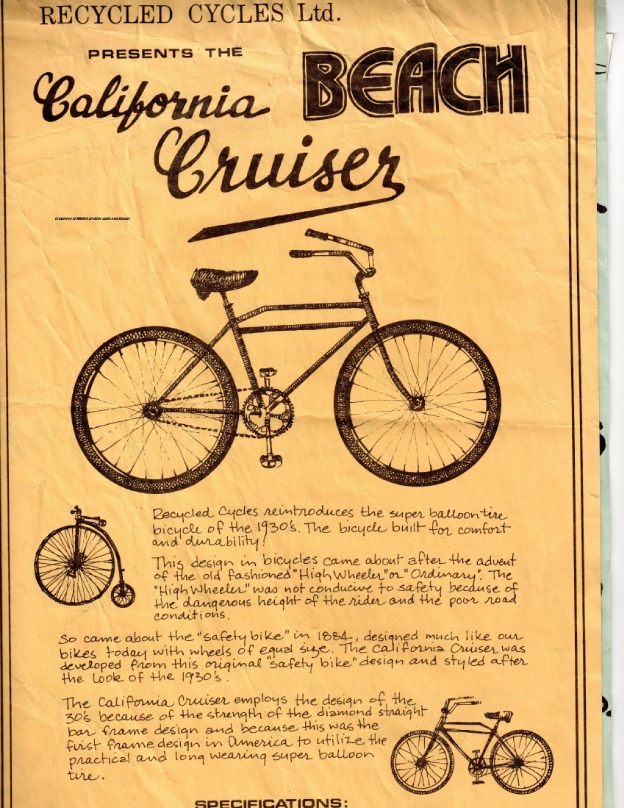
Recently Larry said, "A girl came in one day back in the 1970s and asked me to fix her 3-speed beater import bike. It was a rusty mess, but she said if was more comfy than a 10-speed and she could leave it anywhere and because it was old and rusty and heavy by the standards then, it wouldn't get stolen! She called it her 'Bay Cruiser.' That got me thinking that if that bike was so comfy, a balloon tire bike would be even MORE comfy and perfect for the beach. So I laid out a design like one of my old early balloon frames and took it to LRV industries in El Monte. They asked me if I would supply an old balloon tire bicycle frame to copy. THIS led to production of Recycled Cycles' California Cruiser and THAT's where I got the idea to call it California Cruiser instead of Bay Cruiser." Here (courtesy of NBHAA's files saved since the 1970s) is how one of Larry's first flyers about the bicycle looked in the mid-1970s...
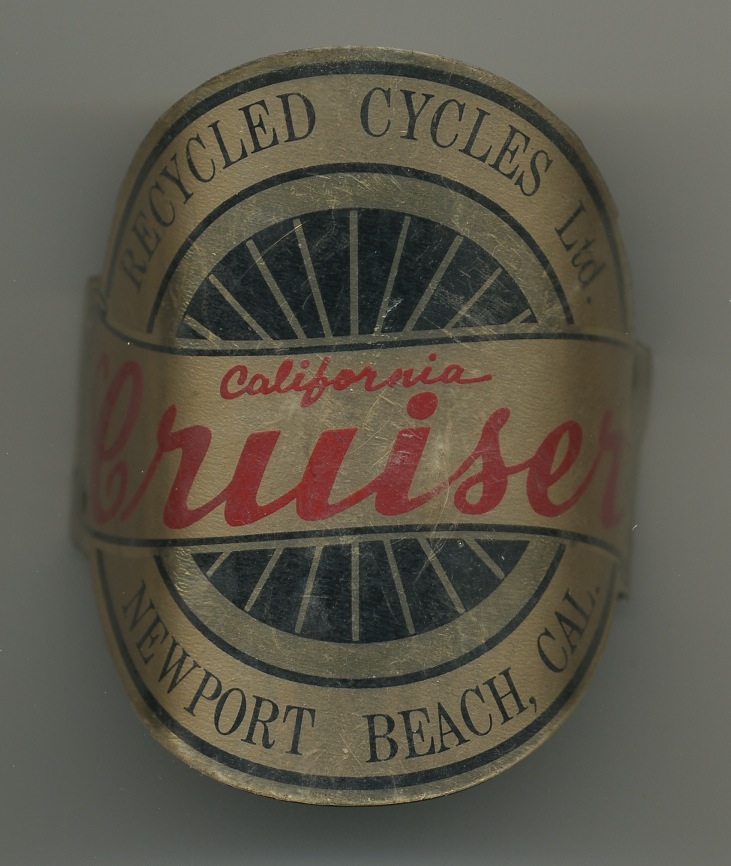
And here (again courtesy of NBHAA's files saved since the early 1970s) is how the headbadge looked for Larry's California Cruiser. Note that this badge is New Old Stock (NOS) and was never mounted on a bicycle, so it still has a protective clear plastic adhesive film over it. This protective film photographs as a rather milky appearance, but we assure you the original badges were quite bright and colorful–and if we pull off the protective covering, this one would be bright and shiny too! And–for you headbadge freaks out there–if this design looks familiar, it was patterned after an old Mead Cycle Ranger badge...
Of course, poor Larry neglected to patent and register his design and people started to smell money. It wasn't long before LRV was making their OWN version of the California Cruiser. Their copy was dubbed (Hmmmmmmmmm) "ROB" (for Regular Old Bike) and their press release read as if we had written it for them (hmmmmm again). Then a SoCal exhaust header company followed soon after with their own copy. Suddenly the beach cruiser thing was a contender in the NEW bicycle realm. It wasn't long before the BIG boys... Huffy, Murray... and the almighty Schwinn came calling.
As odd as it may seem, Schwinn (who became so almost ruthlessly protective of THEIR names and copyrights AFTER we got their Black Phantom and other bicycles popular again) helped themselves to the name California Cruiser. This happened after visiting Larry's shop and seeing the success of the beach cruiser he was making. So for a time, Schwinn decided to resurrect their old full-sized cantilever frame design (up to that time it was barely laboring along in a tiny gray corner of the market under the names "Heavy-Duti" and "Typhoon" with middleweight tires).
The whole time, I kept telling Schwinn, Murray, Columbia, Roadmaster, Huffy and the other American bicycle companies, "Hey guys–market's moved over here! Take a LOOK! Balloon tires! Comfy Seats! Vintage stuff is cool! Some guys in Key West and SoCal are riding these things on the beach. Guys in NorCal are riding these things down mountainsides! People are starting to restore classic bicycles like they restore classic cars! It's NOT light weight that counts so much WITH EVERYONE. For many–it's COMFORT and UTILITY! And STYLE!! You can make money at this!" But they ignored me. They'd stop by my display booth at the trade shows back then (NBDA and BDS-EXPO–predecessor to today's INTERBIKE) and giggle. Then walk away smirking and snickering. Even guffawing. What was all this for? Why was this crazy guy hauling these old obsolete bicycles to shows? Why was Leon Dixon displaying all these old balloon tire bicycles at big bicycle dealer and industry trade shows? What was Leon Dixon hoping to accomplish? (Of course, these same people conveniently forget years later that THIS is how thousands and thousands of dealers and the industry in general–AND THE NEWS MEDIA–became AWARE of these old bicycles after they had already FORGOTTEN THEM!!!) At that time, they thought, "Hey–everybody knows that heavy balloon tires are dead!" They even laughed at us. After all, the market was booming with lightweight 10-speed sales and everybody was darned well gonna ride and want a 10-speed. No matter who you were and what you wanted... you were gonna hunch over dropped racing bars and perch on a seat that resembled a vinyl-covered 2x4, even if it inflamed your gonads and sent you to a doctor... Right? Who cared about the the past? And who cared about the future?
The bicycle companies of the 1970s had professional marketing geniuses. They had staffs of young pros who KNEW (or so they thought) what was going on out there in bicycleland. They had guys with degrees that said they knew all there was to know about making and marketing bicycles. These guys had pieces of paper from those schools that proclaimed they were indeed geniuses. They really didn't need any first-hand knowledge or passion, they had this piece of paper that said they made it through the maze. That's why they got paid the big bucks! Right?
In their view, what happened in the past didn't matter. And the future? They already knew what the future was–and they had their minds made up that it was 20-inch kiddie bikes and 10-speeds. And ANYTHING for adults had to be LIGHT and racing oriented! NO DEVIATIONS ALLOWED! They were pros... and they KNEW the facts! And who was I to tell them otherwise!? They were SMART GUYS! They had their important titles, business cards, long paychecks–and by golly, they were ON THE JOB! How dare any upstart tell them anything different?
The real truth was that the bicycle industry was strangling on its own hubris. It was killing itself, but was blind to it all. The American bicycle business of the 1970s was just like the American car business of the 1980s and 90s. They got this idea that dealers all needed to have degrees in marketing. It no longer mattered how well you knew your local neighborhood in Los Angeles because some school kid in Chicago or some young guy with a piece of paper and fancy title at a desk in New York was gonna tell you how you should run your store! It didn't matter how smart you were or how much business savvy you had. Passion was secondary–even tertiary–to having an ID card that said you made it though an academic maze! Geniuses issued one edict after another. Stuff like all the stores needed to look the same and have the same kinds of lighting.
The bicycle industry in America was simply exchanging one bad problem and replacing it with another. Suddenly, it was like a guy who's just discovered God, then goes out to spread the word and try to change the world. Like a smoker who's just quit smoking, suddenly anyone with a cigarette in their mouth was evil. And the industry HAD to get rid of evil! Things went from one extreme to the other. There was no middle ground. So instead of MIXING the personnel and combining age and experience with youth and a degree, the industry allowed the pendulum to swing all the way in the opposite direction! It was the emperor's new clothes and nobody dared challenge the almighty emperor. There was an ultimate irony that the young president/CEO of one big bicycle company was pictured riding a little kiddie bicycle with training wheels in a commercial advertisement.
So? The big companies slowly started getting rid of anyone who was either too old or who had no degree or special familial relation. The upshot of this was that all of the old-timers and non-degreed personnel were pushed out of key industry positions in just a few years. The "old boy's club" simply became "the new boy's club"and anyone who wasn't a member was barred at the door. And that was that.
Before anyone knew what was happening, kids in their 20s and 30s who had no long-term knowledge of the industry were suddenly put in charge of running things (remember–they had these papers from universities that said they were experts!). These guys were all university-bred and thus, all taught to think the same way. They saw things in one-dimensional ways and tended to have severe limits on creativity. Like Robert McNamara and Viet Nam, they saw the world as ... you do "A"... and the result is "B". But this is the very thing that slowly shot them in the foot. Problem was, they never felt it–even when that foot was turning gangrene!
People who thought like this could never imagine doing "A" and getting a result of "Z"! In their minds, that just couldn't happen. Their university higher-education-linear-thinking had convinced them of this. It was the same kind of prideful blindness that once had the head of the US Patent office proclaiming in the early 1900s that everything that COULD be invented already HAD BEEN invented! (This same blind hubris is so rampant today it has become a cancer on not just the bicycle industry, but the car industry and many others across America.) But as with the "unsinkable" Titanic... and war in Viet Nam (and even later in Iraq, Afghanistan and 9/11 in New York)... AND in the bicycle industry, "Z" is EXACTLY what did happen.
Yet, the companies never realized that it wasn't their marketing geniuses who were predicting trends and swiftly moving to cash in on them. It certainly wasn't the bicycle companies that were inventing new directions to market their goods. No. It was the KIDS in Southern California who came up with different ways to fit out 20-inch bicycles that resulted in the Penguin, Sting-Ray and so-called musclebikes. It was hippies and bikers in the mountains of Northern California who came out with mountain bikes. None of this was a result of bicycle companies being creative; it was the result of bicycle companies merely being REACTIVE. It was their golden parachute. But they never saw it that way. They wanted to think they were being smart and that THEY had caused all these phenomenons. Even today, there are still people who firmly believe this myth.
Meanwhile, the old guys who ate, slept and breathed bicycles–the guys who had life-long PASSION for bicycles–were systematically weeded out. Fired. Let go. Pushed aside. Hey, it was the new frontier! The rules of membership were now all changed. One by one, these poor folks were either laid off, pushed into retirement or put into meaningless positions that eventually discouraged them to the point of leaving (the Japanese refer to this curious phenomenon of the corporate world as having a "window seat").
The bicycle industry (much like the car industry) increasingly isolated itself from the REAL WORLD while its marketing geniuses sat in rooms and studied graphs and charts and held meetings. People that were increasingly left in charge had no idea what was going on out on the street–or how to predict REAL trends. They saw the world only through their university training that told them, maybe they could hold "clinics" and do surveys. Have meetings. Do A and get B. Meanwhile, the bicycle world was doing its own thing–and the people who were making money off of the latest trend ironically were NOT the guys with the business cards, cigars and fancy titles! Like John Lennon once said, "Life is what happens while you're busy making plans to live..."
So when the big guys at Schwinn and elsewhere heard what was going on at the beach in Southern California and Recycled Cycles, Schwinn finally–at long last realized they were missing the boat yet one more time–as they had so many times before and later. So? Schwinn finally stirred to life and did a quick & dirty job of what the auto industry calls "badge engineering." They grabbed the cantilever framed Heavy-Duti, deleted the middleweight wheels and tires, shoved a couple of balloon tires on it, left off the fenders... and VOILA! Instant beach cruiser! So? Schwinn had their OWN California Cruiser. And they brazenly, arrogantly decided to name it just that!


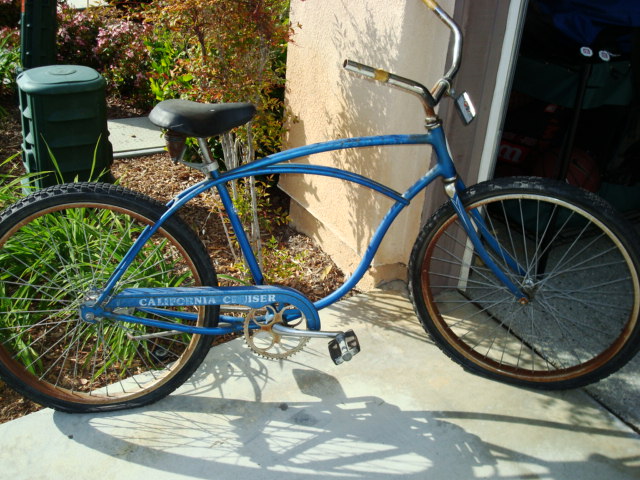
Now, IF you are lucky, you MAY just find one of these someplace with that name on it. If you do–hang onto it because it is fairly rare. Why? Because Recycled Cycles owned the name (it was already being used on their very own retro beach cruiser that was manufactured in SoCal. Yes, it had a badge and everything). Larry and Recycled got their ownership enforced. The result was that perhaps only a few months' worth of production was ever made before Schwinn dropped the name. So if there was ever a collectible beach cruiser, this is probably it–just based on rarity and back story (wonder how long it'll take now before someone comes up with a fake stencil or decal to cash in?).
Murray did virtually the same thing as Schwinn by badge engineering–except they actually took the time to make a fendered version–as per our advice. And they were wise enough to at least pick a name that had SOMETHING to do with a California beach–even if it was not a Southern California beach! And by the way-Murray's Montereys sold quite well for many years. Like hotcakes.
Anyway, the upshot of this all on Schwinn's side was that they hastily changed the name of their beach cruiser from California Cruiser to Spitfire. Ultimately they even added a 5-speed model (as Schwinn always seemed to have a penchant to do–vis-a-vis their Corvette in the 1960s, Sting-Rays in the 70s and other models). Name of the 5-speed? Klunker 5. Of course, the Schwinn guys never figured out that "Klunker" was a name increasingly applied to certain mountain bikes and not beach cruisers. By 1980 when Recycled Cycles had basically disappeared from the scene, Schwinn crept back with yet another modified name because "Spitfire" never connected with the beach scene. So this time, Schwinn simply re-titled their line with the name, Cruiser (which–curiously enough was a name used once long ago on Firestone bicycles). And the springfork version was called DELUXE Cruiser–with a nervy "TM" tag on it, supposedly to protect THEIR name this time. YOU WILL NOTICE THAT NONE OF THESE NAMES REFERRED TO THE TERM, CLASSIC BICYCLES. Try asking yourself WHY?
Nearly a year later after the Bicycling! article, a conversation with Michael Lamm, famous automotive editor, author and historian (whom I also wrote for in automotive publications), sparked interest in both my automotive knowledge and what I was doing with old bicycles. I mentioned to Mike that I had started saving balloon tire bicycle parts and catalogues back in the 1950s and that I had rescued much of the paperwork from the old Whizzer Motorbike Company. I mentioned that I had everything from original factory blueprints to old ads that had appeared in magazines, including Popular Mechanics. THAT got Mike grinning and he said, “Hey, why don’t you do an article for Popular Mechanics? Mike had a relationship with PM at that time and sometimes wrote for them. That led to the first worldwide article ever to appear in a news stand magazine. It was entitled, IF IT'S NOT TOO LATE... HANG ONTO THAT BALLOON TIRE BICYCLE! and in the later Spanish language editions the title was RESTAURE SU BICICLETA. The English version appeared on USA news stands in late 1977 in the January, 1978 edition of Popular Mechanics magazine. The Spanish version debuted later in the March, 1978 Spanish-language edition of PM. Those two articles were probably read by well over a million people. Little did anyone know, but a new hobby was being born right before our eyes.
And if you are lucky enough to find either of these magazines, you will also see that they say, "By Leon Dixon (or "por Leon Dixon in the Spanish-language version). Now, this article was cloned, imitated and repeated and parroted at least twice with bogus info and photos many years later by a Popular Mechanics that had oddly developed amnesia about the FIRST article. Duh-duh-duhhh. Collecting vintage balloon tire bicycles? Leon Dixon? Duhhh, uhhhhh, no. Never heard of 'em until now! In fact, all the way forward in July of 1989 (THAT'S 11 years later, people) Popular Mechanics suddenly had the crust to claim they had discovered a "new hobby" and never even mentioned us! Big companies and big magazines poo wherever they choose and the writer? The individual? They get poo'd ON by the gorilla in the room! That's the way it works. This PM farce was credited to other people who were not around when we wrote the very article that they were imitating. We wonder why. AND...a LOT of people actually believed this bogus clone PM article was the FIRST! If you happen to have both magazines, take a very close look at them BOTH. Look at the covers. Apparently, Popular Mechanics was so bankrupt for creativity they even cloned the cover of the original 1978 issue and used a graphic of an aircraft tilted at a 45-degree angle! How sad. And the hokum they published got re-cloned again! It snowballed. OTHER magazines also copied what we said, but again, made it look as though the ideas and info originated with THEM! Today, you CAN look at the historical record and know this is all bullcookies. We get accused of having a big ego, but all we have ever wanted was credit for what we have actually DONE... rather than seeing others TAKE that credit pretending somehow that THEY did all this... or that it all just fell out of the sky like some miracle. How did the Schwinn Phantom get famous again? WE CAN ASSURE YOU... WHEN THIS ARTICLE (AND OUR NEWSLETTER WHICH HIGHLIGHTED THE PHANTOM) FIRST APPEARED, THE PHANTOM WAS WELL FORGOTTEN BY NEARLY EVERYONE. BUT SUDDENLY EVERYONE HAD SCHWINN PHANTOM ON THE BRAIN. TWENTY (20) YEARS LATER WHEN THEY FINALLY REPOPPED THE THING AND WANTED "ADVICE," AND AFTER ALL OF THE FREE PROMOTION WE GAVE IT FOR TWO DECADES... DID THEY CALL US? WHAT DO YOU THINK?
AND NOW... you'll want to read the very first worldwide article that introduced collecting American-made balloon tire bicycles. This was the FIRST time that Elgin Bluebird, SCHWINN PHANTOM, Elgin Skylark, Whizzer motorbikes and other balloon tire bicycles were presented IN PRINT TO THE WORLD AS COLLECTOR ITEMS. FIRST IS a big thing... copying and imitating FIRST should NOT be.
THIS WAS OVER 30 YEARS AGO...
AND GUESS WHO WROTE IT???
Wanna see more of our early participation in forming the classic bicycle hobby? Look here... CLICK HERE. This is the March 12, 1979 article in which Leon Dixon appeared in SPORTS ILLUSTRATED magazine promoting classic balloon tire bicycles and collecting them. WHERE were our imitators and critics THEN??? WHAT were they doing to get this hobby on its feet?? Hmmm???
AND...Wanna see even more of our early participation in forming the classic bicycle hobby? HERE is the very first published DEFINITION OF A CLASSIC BICYCLE. Read the article, then view the copyrighted definition we made in the NOVEMBER, 1979 ISSUE OF BICYCLE DEALER SHOWCASE magazine. This was one of the big trade magazines in the bicycle industry and was read by over 20,000 dealers and thousands more in the bicycle biz at that time. When you read the article, note how Leon Dixon begs bicycle dealers NOT to toss out old bicycles and parts. He tells them FOR THE FIRST TIME that there is a MARKET for vintage bicycles and parts! Also note how we were the first to promote vintage Rollfast bicycles (yes, we had large files of the literature even in the 1970s). Want to thank somebody for the fun you are having in the classic bicycle hobby? Want to thank somebody for the cash you make today selling your old parts and bicycles? HERE is where your thanks belong! When somebody asks how Leon Dixon got this info spread to so many people, THIS is one of the ways. And NOBODY had EVER published such a definition or category before! And finally... if you are wondering about the yellow highlighted sections of text in the article? Those are passages that were pirated WHOLE and used to make a similar article that appeared in July, 1981 issue of American Bicyclist magazine where this original article was plagiarized....
THE BDS ARTICLE AND COPYRIGHTED CLASSIC BICYCLE DEFINITION WAS OVER 30 YEARS AGO...
AND GUESS WHO WROTE IT???
This is the NOVEMBER, 1979 article in which Leon Dixon's coining of the term, "CLASSIC BICYCLE" and the copyrighted definition appeared in BICYCLE DEALER SHOWCASE magazine promoting classic balloon tire bicycles and collecting them. WHERE were our imitators and critics THEN??? And WHAT were they doing to get this hobby going? Hmmm???
Whoever you are... ask yourself... what were you doing in November 1979 that had to do with classic bicycles and a classic bicycle hobby? ASK yourself.
Until our next installment, we'll leave you with a question: WHO were the people in the 1981 photo below and what were they doing? Of course, it involved old bicycles! And by the way, your NBHAA curator is in the photo. See if you can pick me out. And if you've got VERY sharp eyes, you'll notice that the sign above the overhang says "SCHWINN PARTS DIV." We will tell you that the person standing third from the left was Schwinn's famous Keith Kingbay. Also, be sure to check out the new information and articles added to NBHAA Historical articles section, now including a list of major bicycle articles written by Leon Dixon.

PART TWO:
THE REAL BEGINNINGS IN SOUTHERN (AND NORTHERN) CALIFORNIA IN THE 1970s...
CALIFORNIA BALLOON BIKE & WHIZZER NEWS...
CLASSIC BICYCLE & WHIZZER NEWS...
AND... JUST A LITTLE BIT ABOUT THE SCHWINN HEADQUARTERS AND MUSEUM IN CHICAGO IN THE 1970s–WITH PHOTOS...
copyright ?Leon Dixon, 2011. All rights reserved
Still wondering who those people were in the photo? Well, wonder no more. Curiosity is one good sign of intelligence. Lack thereof... is usually a lack thereof. So if you've read this far, we'll presume it is safe to say you belong in the "intelligent" category and you don't walk with your knuckles on the ground.
Anyway, the people in the photo were just some of the attendees at the very first National Classic Bicycle Club of America (CBCA) meet...conceived and sponsored by Leon Dixon... and held in Chicago during 1981. For the very first time EVER, Leon Dixon held a NATIONAL swap meet for balloon tire bicycle collectors, held a tour of the Schwinn bicycle factory (yes and watched them actually MAKE bicycles)... and took the very first group of Classic Bicycle collectors through the Schwinn vintage bicycle collection in their "museum." The photo was taken at the loading docks of the old Excelsior building where the collection was housed at that time. Look closely at the overhead sign on the building and you'll note that is says "Schwinn Parts Division." How time passes. Many of these participants shown are already deceased.
That's Schwinn's Keith Kingbay third from the left in the back row. Keith was a great friend and great bicycle man. He was also the first curator of the Schwinn vintage bicycle collection and hosted our tour through that collection. Next to the right of the photo is Steve Uppman with the camera hanging around his neck. Counting two more over to the right is Gary Schwartz who back in those days had a fledgling business with partner John Bade called "Gee and Jay Bicycles." Later this became Hollywood Bicycles of Minnesota. Count ten more heads to the right and that's Denny Schwartz, Gary's brother. Drop down to the front row, lower right corner kneeling... that's Bruce "Doc" Natkin of Southern California. Doc was a great guy and great friend who loved old bicycles. Next left in the photo is Jim Lucas–a great friend and very knowledgeable collector of motorized bicycles. Then next to him is Harold Bruce of Ohio who was the reigning Colson expert of the hobby back then. He should have been. He (along with Jim Lucas) was from Elyria, Ohio where the bicycles were made. When THIS PHOTO was taken THESE people (along with perhaps ten to fifteen others who were not here) were the core, the nucleus. They were THE CLASSIC BICYCLE HOBBY. And virtually everyone in this photo met each other one way or another through Leon Dixon. PERIOD. Several of the people in this photo (including Mr. Kingbay and Jim Lucas) have passed on since then and we were lucky to know them.
Jump from 1981 to today and there are all kinds of bizarre stories being passed around. Wild stuff. And myths set in stone. One fellow who is considered a major expert with a big following and a broadcast show says that by the late 1980s when HE got into bicycles, Schwinn supposedly never saved an Aerocycle or other significant classic-era bicycles. He claims that Schwinn somehow needed HIM to help them find these bicycles (actually they already had them in the 1960s and 1970s and you'll soon see proof of this fact). The same expert also claims that one Jim Hurd was the "first curator of the Schwinn museum"... again not so (first curator was Frank Schwinn, followed by Keith Kingbay... followed by Carl Wiegand). And people call us crazy. What can be crazier than these ridiculous stories that people just plain make up and give to Wikipedia and TV and newspapers (who publish this silliness) and hobbiests as if–oh yes–THIS is real history? We don't write fairy tales here and pass them off as facts. And we are not guessing at what we say.
Of course, if you read the ORIGINAL and FIRST newsletter for the hobby, Classic Bicycle & Whizzer News back in 1981, you would already know better than to believe these things being claimed today. But since so much time has passed, it seems that this original newsletter that started things has conveniently been erased from the record, despite that its aim, subject matter and even title are still being imitated in 2011. We called it "CBWN" for short. You simply imitate, copy something that came before, but pretend you never knew about it, then repeat the same info to people today that was around 30 years ago–all while acting as if it came from you! Pretty good huh?
So... in this installment, we'll be taking you on both a tour of Schwinn in the late 1970s... and we'll show you that Aerocycle that Schwinn supposedly never had (actually they had two of them back then)and a lot of other amazing things. AND THEN we'll show you the newsletters that started this hobby and defined ALL of the major collector pieces that STILL until this day remain as we always predicted they would... over 30 years ago...
Someone recently wrote and asked the moronic question, "Why is it so important for you to get credit for the stuff you did?" WELL? WHY NOT? What kind of a jackwagon question is that? I didn't just jump into this thing recently. I don't run a DIY web site or a "forum" or a "BLOG." God bless them and the hobby probably needs these things, but in "forums" and BLOGS anybody can make up and say whatever they want and THAT becomes "history." Like the story that claims Indian bicycles were made in England in 1948 (actually they were made in Ohio in 1948 AND 1949...and we're NOT guessing at this). And just because you get 50 guys to agree that they made pink Schwinn Phantoms on Christmas day in 1922 STILL doesn't make it a FACT. I don't put out publications and "histories" with 30-40 guys all "contributing"(that usually means guessing) and claiming they "worked years coming up with all there is that exists" (which almost always is nowhere NEAR what NBHAA has)...and doing WAGs and then selling it to you with fine print saying things like "don't bet the farm on this!" I could use pen names like "TooLoose La TREK" or call myself "Vintar Peequar" or "Pozo Seeko"... but I don't. I tell you who I am and I stand by what I say as FACT–because it IS. Even if some of these folks can't stand to hear it. And this may be hard for SOME folks to comprehend. It may be even harder for others to accept... but it IS possible that one individual knows more than a bunch of guys guessing and swapping stories.
While it is true that SOME people think it is a kind of noble status symbol to do things totally anonymous...but so what? I'm NOT John Bearsford Tipton III. To ask why someone would want to be acknowledged for what one has actually done is just downright strange. And if you don't think so, what can we say? The Russians and Chinese thought like this for a lot of years where everything done is communal and no individual gets credit for what that individual has actually done. People, there is a term for this kind of anonymous production concept where the only names that get honored are those chosen by the powers that be: it's called COMMUNISM. Look where it got them?
MORE ON THE RETURN OF BALLOON TIRE BICYCLES AND THE BEGINNING OF THE CLASSIC BICYCLE HOBBY....
THE FIRST NATIONAL CLASSIC BICYCLE SWAP MEET AND SHOW...
NOTE: People are funny. They tend to acknowledge whoever wins the popularity (or the other unmentioned) contests, or whoever is a member of a group. Anyone else doesn’t exist unless the group says so. Gotta be a crony to get a boney.
And people only live so long. Tom Bruck is gone. Keith Kingbay is gone. Steve Ready is gone. Don McNeely is gone. Jim Lucas is gone. And a lot of others who were around when all this began are no longer with us.
Meanwhile, others–many of them newbies who were never there–are stepping in making up their own stories, claiming expertise. It is in their myopic, biased interest to do all they can to pervert the history of the hobby and divert the credit for how it began. To make it theirs, they have to revise and re-write reality?making the hobby anonymous, communal…generic. Nahhh?this whole thing just fell out of the sky? it’s a big coinkydink! Yeah?that’s what it is! Some books will even make it seem as though there are no sources other than clubs or communal groups of collectors pooling their guesses to come up with “histories.?Some of you will believe them. Some of you NEED to believe them. Some of you PREFER to believe them. Some people will tell you that you don’t need to rely on expertise, don’t pay anyone for expertise?you can be an expert too–for free! Just go buy books! If you don’t see the absurdity of such a statement, then by all means–go buy the books (uh, WHICH books and how to interpret them?). Meanwhile, guess we’ll just have to tell you the real history here.
Today there are those far and wide who will step forward to claim expertise in classic bicycles. But that wasn’t the case just a few decades back. In the mid-1970s it was pretty obvious that there was no real snob appeal in classic balloon tire bicycles. Unless you were at the beach in Southern California, hanging around one of the Recycled Cycles shops in Orange County, California or in the Florida Keys, ballooners had little dollar value. And vintage bicycle collectors? Ha! People who saw themselves as “serious?bicycle collectors back then would quickly, overtly, snobbishly turn their noses up at anything newer that 1900–with the odd exception of the weird Ingo-Bike (why, we don’t know). They didn’t want balloon stuff at their meets or exhibitions. They laughed at it and worse. They’ll deny it today when a whole new regime of folks has joined those ranks and want to now imagine they are magnanimous. But frankly in the 1970s most people we knew who figured they were “serious?bicycle collectors just plain hated anything made after so-called “hard-tire safeties?(which even these were only grudgingly accepted). Balloon tire stuff? To so-called “serious collectors?it was pure low-echelon junk with no historical value. Not even worthy of discussion, much less recognition! It had no classifications, no icons, no respect, no publicity, no club acceptance, no icons, no experts, no real history, no books–not even mention in books, no names that were respectable–except for maybe “cruiser?(which in Southern California was pronounced “crrrrrrrewwwwwwwwzzzer?. And that was that.
So it was clear that a new bicycle hobby needed to be established with its own category, top collector pieces and its own history. It would need to start in the era that followed with the antiques and contraptions left off. So? I coined the term, “classic bicycle,?wrote its definition and delineated it was a separate collector class from pre-1920 antiques. Voila! Two separate entities: antiques…and CLASSICS. But it was an uphill battle. How uphill?
In realm of bicycle collecting during the 1970s, if you weren’t collecting highwheels, hard tire contraptions or draisienes, you were nobody! You didn’t even exist as a collector! And anybody else doing “serious?collecting only wanted to talk about “Campy gear”…imported lightweights …and racing …and how light your bicycle was. If you collected balloon stuff or dared mention it, you were an insect!
And it wasn’t just the so-called “serious bicycle collectors.? Most bicycle books of the day completely ignored classic-era American bicycles. These books jumped–leap-frogged completely over the classic era in histories–as if American balloon, singletube and middleweight bicycle never even existed. Don’t believe me? Here are three bicycle history books from the 1970s-80s:
?EM> Bicycling-- A History, Frederick Alderson, New York, Washington: Praeger Publishers 1972 (no mention or photos of classic bicycles)
?The Complete Book of Bicycling, Eugene Sloane, New York: Trident Press 1970 (no mention or photos of classic bicycles in extensive history section)
? Bicycles. Fermo Galbiati and Nino Ciravegna, San Francisco: Chronicle Books 1989 (no mention or photos of classic bicycles even at this late date due to a Euro-perspective of the authors)
You’d think in bike-happy San Francisco that surely they’d include American balloon tire bicycles in their histories? But no. And they’re trying to return to this oddly and hugely biased and untrue “history?again today. Don’t believe it? Go to your bookstore and check again the most recent three hardcover books published on vintage bicycles and bicycle history if you doubt me. The Euro-sourced books can be somewhat forgiven in light of the fact that Classic Bicycles were an American phenomenon of which they are largely unaware. But American bicycle history books? One of them was published this past year out of San Francisco. Again, portraying itself as a bicycle history book, yet completely devoid of even one classic American bicycle. Not ONE.
Anyway, the late Steve Ready, co-founder of Interbike trade show had been encouraging me to hold display exhibits of my vintage classic bicycles for several years beginning back in the mid-1970s. My exhibits at these events were always the hit of the show. It was typical to have people gathered so deep around the display that adjacent booth operators would sometimes complain. They said that we were clogging the aisles and thus hurting their potential sales due to the traffic flow (or lack thereof) situation. Those were some strange times for the classic bicycle. On one hand, you had people pointing and laughing?and on the other you had people pointing and going Oooooo and AHhhhhhh! There was no middle ground.
We approached publishers with an idea to do a book on classic bicycle history and collecting. Most just were perplexed and had no clue. Most asked us ridiculous questions like, “…are you going to include diet and exercise tips??Or another asked, why don’t I see any listing of racing champions in here–don’t you think you need that too??No. One car book company we approached swore they would NEVER get involved with old bicycles (and YES, we still have the rejection letter stating so)?then years later after we got the hobby on its feet they hired one of our imitators to do the very thing they claimed they would never do!
Today, people ask things like, how did Leon Dixon get these old bicycles known as collector pieces all over the country when he’s just one guy? Well, tens of thousands of bicycle industry people attended these trade shows alone. AND I wrote articles for magazines (these appeared internationally) and appeared in other magazines. I also appeared at the trade shows with my exhibits of vintage balloon tire bicycles. And I also tirelessly did free displays all over creation. I appeared on radio and TV. And I did these things long before the idea occurred to others that want to take credit for being today’s “experts?on the subject. THAT’S how.
(PHOTO COMING HERE)
At first, there were industry people who made fun of me and my exhibits. Didn’t I have some new product that was going to fit on a 10-speed? Nope. Did I have some new kind of lightweight frame and boffo gear shifters that were gonna turn the bike biz on its ears? Nope. How about plastic disc brakes? Nope. Airless tires made of recycled plastic and newspaper? Nope. Helmets? Nope again. Then what was all this old stuff about and why was it here? If I wasn’t selling something, why was I here? How was I making money? After all?it was only all about making money–wasn’t it?
I would also get these guys who imagined themselves as “with-it?or “serious cyclists?who would give me long lectures about how heavy all these old things were and –OMG!…why would anyone want to pedal such a heavy thing? They would ask what kind of macrobiotic diet I was on and if I did “carbo-loading?before I rode? Or how many miles would I ride at an average outing. They gave me tips for keeping my legs in shape and asked if I did cadence pedaling. Stuff like that. They’d look at my mint condition Whizzer Special and ask about why this bicycle had a motor on it? And why did most of my bicycles (including the ones with no motors) have “gas tanks? And what was that weird pink plastic bike I was riding around the convention hall (it was my Bowden Spacelander)? Was I thinking of entering it in the human-powered land speed championships? And why design something that looked so streamlined if it did go insanely fast? They just didn’t get it.
And then the early mountain bike folks eventually began to show up. In anticipation of what was going on with them, I suggested a spring fork design for mountain bikes and cruisers to a friend, Phil Huff. We were wayyy too far ahead of our time. Poor Phil actually made a bunch for sale and brought them to one show in Long Beach, California. The beautiful chromed fork had Delrin bushings and a totally rider-adjustable spring tension. Advanced as hell. We set it up in a separate booth where people came by and did little more than argue and laugh at it. Here are some of the comments:
?Why would anyone riding down a mountainside want to give up the raw, rough-riding, mud-in-your-face experience with a cushioned suspension?
?Some moaned that it would “soak up your pedaling power?BR>
?Others complained it would add weight!
?Some said it would “ruin the fun”…so help me! They actually said that!
I wrote a lot of the comments down. Weird when today you can’t sell a bicycle without suspension! Funny how times change and how short memories are.
But back at my booth, I always had an audience with baby-boomers and most dealers who remembered these old bicycles. They would often walk up to my exhibit and stand there for hours on end just looking and talking. Reminiscing or admiring the sleek designs and the chrome. Many would return several times. The weight to these folks didn’t matter any more than the gas mileage on a classic car. They knew …and completely understood what and why these bicycles represented. I never had to wonder about dinner after the show?it was always offered and wherever I sat–in whatever restaurant it might be, the table was always full and buzzing! It got to the point where some big folks in the industry would eventually show up and whisper things like, “I don’t know what this all is, kid, but you’re onto something!?p> To this day I have a huge stack of bicycle industry business cards collected over the years. Enough to fill several binders. How did the old surviving bicycle companies get re-interested in balloon tire bicycles? Well? How do you think? Magic? It didn’t just fall out of the sky! It was years of appearances, talks, articles and communications all from yours truly. The president of Columbia came by along with an entourage?on several occasions (yes, I have photos of us together when I accepted serial #2 of Columbia RX-5 reproduction). The head buyer for Western Auto (Western Flyer) came by and marveled over my Western Flyer X-53 (soon after they went back into the balloon bicycle biz with “replica?editions). Ed Schwinn, Rudy Schwinn and many others from that company came by (and yessss, they got the idea–admit it or not–of repopping their Black Phantom from ME after seeing me ride mine around the shows and watching the dealers grin). The former chief bicycle guys from Sears came by and were shocked to see my J.C. Higgins sparkling in the booth (next thing I knew there were beach cruisers at Sears suddenly branded “J.C. Higgins?after years of the name being dead). Crews of people from Murray Ohio came by (yes, I still have their biz cards and I was asked to consult with the company on ideas about making balloon tire bicycles again. The first result of which was their adoption/resumption of the color “Flamboyant Black Cherry?on their balloon tire bicycles). Robert Huffman (Huffy) and others from that company came by and marveled over my Huffman/Dayton/Huffy bicycles on display (they took particular interest in my NOS Huffy Radiobike which they eventually bought back and displayed for years in Dayton, OH). And former Whizzer Company people and factory dealers came by my booth and all wanted to look at my Whizzer Special and see my Whizzer literature (need we tell you what happened with Whizzers getting repopped since then?)! And many more.
It is always easy to stand very tall when you are doing so by placing your feet so that you are standing on somebody else’s shoulders. But for all of the critics, people who have big web sites, sell bicycle collector books, sell old classic bicycles and parts on eBay, hold classic bicycle swap meets and do TV shows?like it or not, you know who you ought to be thanking–and it’s not yourselves.
Today there are people out there who want you to believe this all just happened by accident. One fellow said to me in recent years, “Well maybe your did or maybe you didn’t but it woulda happened anyway because this stuff is so cool!?Really? My response to that is everything has a beginning, and just because there are people who refuse to credit me for all my hard work, does not mean it never happened! This hobby was NOT an accident. Nor was it a coincidence. It is easy to walk into a ready-made hobby, decide you like it and then make up whatever stories you want to identify yourself as a player. But where were these people back in the 1970s and what did THEY do to get things started and keep things going? When did they catalogue the histories of the bicycles and the companies that made this stuff? Where is their evidence of expertise?
Anyway, eventually I decided that IF there was going to be a real, visible, nationwide classic bicycle hobby, it needed what worked for the vintage car hobby: clubs and a spectacular annual meet. This is something I set out to accomplish.
First I started a newsletter in 1977. The early version was called “California Balloon Bike & Whizzer News?and there had never been anything like it. I later changed the name to “Classic Bicycle & Whizzer News.? This newsletter was the world’s first recognition of balloon tire bicycles as bonifide collector items. No one had ever done such a thing before. Whether you remember it or not–whether you like it or not, this was a milestone. But for me, it was also a millstone. I devoted untold energy and funds into promoting a hobby that barely existed. There were a couple of guys with shops selling vintage stuff and there were scattered others mainly selling “old Schwinn stuff?around the country?but no real hobby. Everything was either “old Schwinn?or “old Whizzer?stuff and that was that. Mention a Dayton, a Huffy, a Murray, a J.C. Higgins, a Bowden, a Roadmaster, a Ranger or anything else and all you got were duh-duh-duh! While there are many today claiming expertise on these things now?but in the 1970s where were these people? NOWHERE. Ask these people to SHOW you where they were and what they were doing with this stuff back then? For many years to follow I was the lone voice trying to unite collectors and get a genuine hobby on its feet as a real, visible entity–not merely some underground interest of a few.
Next, my idea was to hold a large national bicycle meet designed to cater NOT to people collecting highwheels and antique contraptions, but to appeal specifically to people interested in balloon tire bicycles. More on this later because first I needed to give it publicity on a massive scale. I did this first with an article I wrote for Popular Mechanics magazine in 1977. It was published in January, 1978 and went around the world in at least two languages. The Spanish edition came out in March of 1978. My friend, famous automotive writer/historian, Michael Lamm was West Coast Editor and was quick to recognize an article such as this could be a big hit. It was. The title was, “If it’s not too late…Hang Onto That Balloon Tire Bicycle?/EM>. And this very article broke the floodgates and resulted in hundreds of letters from people who thought they were alone in their love for vintage balloon tire bicycles! Finally a real hobby was beginning to take shape (sadly, posers and imitators published similar articles YEARS later in the same magazine which apparently developed amnesia about the fact that it had already been covered. Laughable statements referring to a “new hobby born?were still being mysteriously parroted back a decade after my article in Popular Mechanics).
In those days Interbike co-founder, Steve Ready was also editor of one of the bicycle industry trade magazines, “Bicycle Dealer Showcase?/EM> (no apostrophe “s?in the title). Steve asked me to contribute some info and then to write a few articles for the magazine. In one of these, Steve called me and said “Hey, Leon, I notice all the people gathered around your bicycles at the Expos, but nobody knows how to classify them. What do YOU call them and why don’t you write this all up in our magazine so dealers will know what’s going on? You can also let the world know that you are trying to start a hobby with a new era of bicycles that have not really been recognized yet! The upshot of Steve’s request was an article that I wrote and Steve published in the November, 1979 issue of Bicycle Dealer Showcase magazine. The article was entitled and it contained a complete copyrighted definition of “Classic Bicycle?/EM> as it is now understood among collectors in 2013. It was the very first article of its kind in a bicycle industry magazine and the first definition of the classic bicycle hobby. This definition identified the era for approximately 1920 to 1965 as the classic era and included America-made singletube, balloon and middleweight bicycles. You can see this very article in the “Historical Articles?section of NBHAA.com. It was so significant that my article was blatantly plagiarized in the July, 1981 issue of American Bicyclist magazine. If you can find the article, read it and count how many full sentences with out of my BDS article are ripped off and carried over intact.
One Einstein of recent years seeking to resist crediting me said, “Hey Leon, you didn’t invent the word, CLASSIC!?Everybody’s a smartass today. No?I didn’t. But I did invent the definition as it applies to vintage bicycles and collecting them. I did it before anyone. And I did invent the concept and the era for bicycle collecting as it is now understood today. Why would anyone in his or her right mind want to argue that–especially people who were not even involved in the hobby then? Why?
Anyway, at long last, it was time to move on putting a national event together. It would have to be something never done before and I was determined to pull out all the stops to make it happen.
I was continuing correspondence with my old bicycle friends Tom Bruck in Chicago, Illinois and Keith Kingbay of Schwinn, also in Illinois. We got talking about Frank Schwinn’s huge vintage bicycle collection that was gathering dust in the old Excelsior building. I concluded that I was going to do something to share that treasure with people who could very well become inspired collectors and the nucleus for a real hobby. It would have to be a new hobby because up until then, all that existed was a scattered smattering of a handful of people with pent-up interest but no way to enjoy it or express it. I pulled out my credit cards and decided to go into hock for a hobby that would never thank me. My first stop to get things going was a flight from California to Schwinn in Chicago. The years were 1978 and 1979.
A couple of visits were all it took to scout locations, see Frank Schwinn’s collection and make arrangements with Schwinn to bring a group of collectors through their factory. It was expensive and I also realized that it would be a lot for one person to pull off. I had to run advertisements (aside from my newsletter, there were no hobby papers so I had to run ads in the Chicago newspapers), buy trophies, plan locations, get approvals, determine how large (or small) the meet and number of attendees would be. This was a colossal amount of work. Due to a divorce I had to postpone the actual show. It would not take place until September, 1981.
Schwinn headquarters in Chicago in 1978. The front door led to the lobby and the arrow here is pointing to the big metal letters over the marquee that said, “SCHWINN”…to the right was the Service School?to the left was the cafeteria?p>
(PHOTO COMING HERE)
Ignaz Schwinn’s family tandem on display in the Schwinn headquarters lobby?p>
(PHOTO COMING HERE)
(PHOTO COMING HERE)
TO BE CONTINUED?
KEEP WATCHING! Stay tuned and watch this space for MORE amazing stuff about the early days of the hobby and beginnings.

Click on the colored letters at right to : Send Email to NBHAA
This page, all design and contents, all photos unless otherwise noted are Copyright ?1996, 1997, 1998, 1999, 2004, 2007, 2008, 2009, 2010, 2011, 2013 by Leon Dixon/NBHAA, All rights reserved. The information and photos on this website may not be reproduced in any form without expressed written permission of NBHAA or its curator.
Date of last update to this page: November 2013
